The lightest cordless drills that still do a day's work
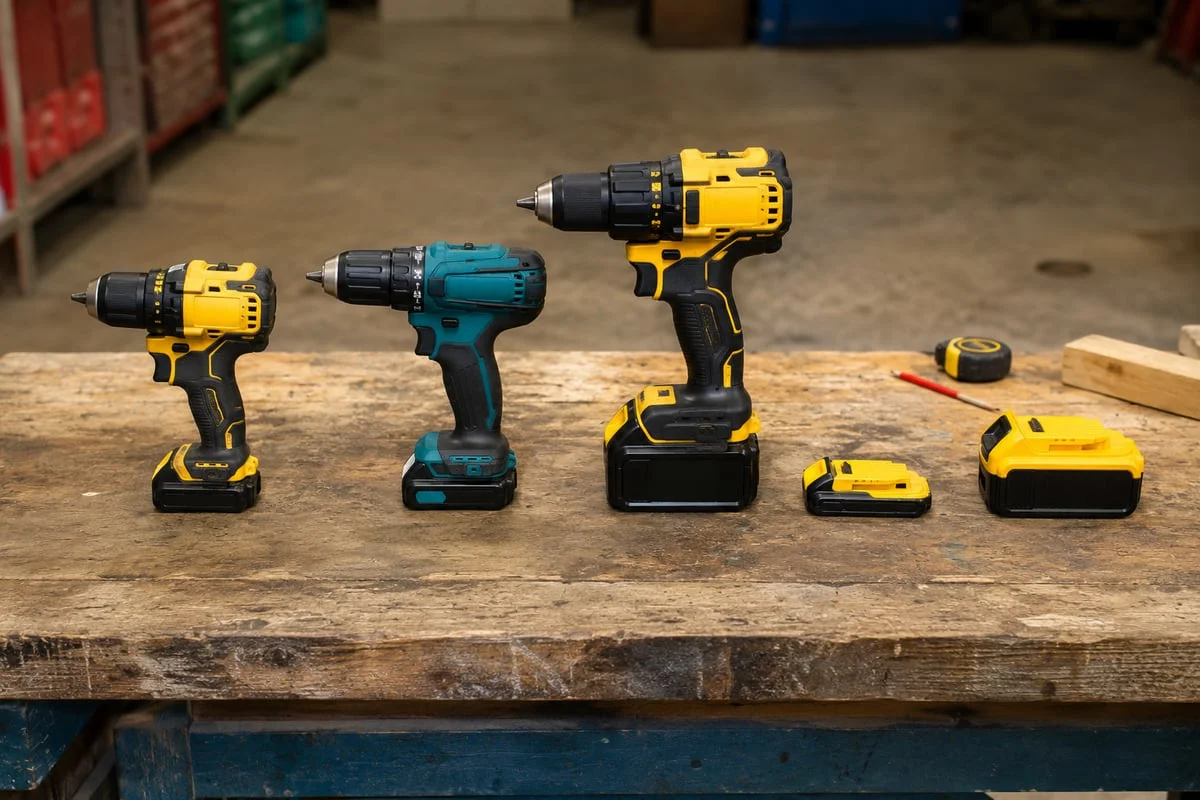
Four drills, weighed bare and with the battery, ranked lightest first. Judged on the thing your shoulder notices at 4pm: weight in the hand, against the torque you actually need and the payback on your day rate.
By Still Grafting // Research-led guide // Updated June 2026 // 9 min read
No time? The picks in ten seconds
Best overallDeWalt DCD701 (12V). About 0.9kg bare, yet 57.5Nm. The featherweight that still drills like it means it.
All-day light workMakita DF332 (12V). Around 1kg, faultless balance, the one fitters and electricians reach for without thinking.
One drill for everythingDeWalt DCD800 (18V). Heavier, but 90Nm for when 12V runs out of puff.
Heads up on the links. Some buy buttons below are affiliate links, marked (ad): buy through one and we earn a small commission, at no extra cost to you. The rest are plain links we earn nothing from. Either way, every pick here is locked before any link goes in.
How this guide was made: built from manufacturer specs, weights checked against multiple retailers, documented long-term feedback from working tradespeople, and tracked prices. No hands-on claims are made that did not happen. Want to join the test bench and get free kit for honest feedback? Sign up to Site Notes at the bottom of the page.
Why a lighter drill is a business decision
You pick a drill up and put it down hundreds of times a day. A sparky on a second fix, a kitchen fitter on a run of units, a plumber under a bath: it is not one heavy lift, it is a thousand small ones. Over a year that load lands on your wrist, elbow and shoulder, and those joints do not grow back.
The trade has spent twenty years chasing power and forgetting weight. For most day-to-day drilling and driving you are nowhere near the limit of even a small drill. What you are near, by the end of the week, is the limit of your arm.
The Payback Score
How many lost working days a tool must save to cover its cost, against your day rate. At a £280 day rate, a £60 drill pays for itself the moment it saves you a fifth of a day, once. Every drill here clears that bar easily, so cost is not the question. The question is which weight you want to be holding at the end of a long day. Run your own rate through the calculator.
Foreman's note. The lightest drill here is not the most powerful, and the most powerful is not the lightest. That is the whole trade-off. Buy the lightest one that covers the work you actually do, not the work you do twice a year.
Key facts
Quotable and checkable
The DeWalt DCD701 weighs about 0.9kg as a bare tool and delivers up to 57.5Nm of torque, unusually high for a 12V drill.
The Makita DF332 weighs roughly 1.0 to 1.2kg with a battery fitted and delivers 35Nm, in a body 154mm long.
The DeWalt DCD800 is an 18V drill delivering 90Nm at 164mm long, heavier than any 12V here but far stronger.
Battery choice changes total weight more than the drill does: a 5.0Ah battery can weigh close to half a kilo, roughly double a 2.0Ah.
A brushless motor (no carbon brushes to wear out) runs lighter, cooler and longer than the older brushed type, and the price gap has all but gone.
The lighter the battery, the lighter the day. A 5.0Ah battery can weigh close to half a kilo more than a 2.0Ah, more than the difference between the drills themselves.
The picks
Best overall · most trades
DeWalt DCD701 (12V XR brushless)
The trick here is torque in a tiny body. Most 12V drills make you accept less power for the lower weight. The DCD701's brushless motor pushes 57.5Nm, which covers the vast majority of trade drilling and driving, in a tool of about 0.9kg before the battery goes on. At 152mm long it noses into spaces a full-size 18V will not reach, like the back of a consumer unit or a base cabinet.
The honest limits: it is a drill driver, not a combi, so no hammer action for masonry, and for big spade-bit holes or long structural screws all day it runs out of legs before an 18V does. For everything else, it is the one to beat on weight.
Worth knowing about precisely because you should not buy it. The older brushed DCD710 weighs almost exactly the same as the DCD701, about 0.91kg, but manages only 16Nm against the DCD701's 57.5Nm. Same weight in your hand, roughly a third of the work, for the sake of saving twenty quid. This is the clearest argument on the page for paying the small premium to go brushless.
Weight (bare)approx 0.91 kg
Max torque16 Nm
TypeBrushed drill driver
VerdictSpend the extra, buy the DCD701
All-day light work · electricians, fitters
Makita DF332 (12V CXT brushless)
Makita's 12V drill is not the most powerful at 35Nm, but balance is not a number you can read off a box, and this is where it wins. For a sparky on second fix or a fitter running screws into units, how it sits in the hand over ten hours matters more than a torque figure you never reach. Around 1kg with a battery, 154mm long, and the soft grip disappears in use.
Two honest caveats. The torque ceiling is real, so it is not the one for heavy or repetitive big drilling. And the 12V CXT battery does not share with Makita's 18V LXT tools, so if your van already runs on LXT, factor in a separate charger and batteries.
The heavy pick on a page about light drills, and that is deliberate. Some work genuinely needs an 18V: decking, joists, 50mm-plus holes, long structural fixings, and with the hammer-drill version in the same range, the odd wall plug. The DCD800 delivers 90Nm at 164mm, short for an 18V, so it is about as light as full power gets. It is still clearly heavier than the 12V pair, and a big battery makes it heavier again.
Which is the whole lesson: the tool is not the problem, the battery is. Pair it with a small 2.0Ah for first fix and light work, and save the 5.0Ah for when you actually need the runtime.
Weight (bare)approx 1.6 kg
Max torque90 Nm
Length164 mm
TypeBrushless drill driver
Street price£132.99 body only (Amazon, checked 10 Aug 2026)
Here is the thing nobody selling you a drill mentions. The number on the spec sheet is usually the bare tool. The weight in your hand is the tool plus the battery, and the battery is the bigger variable.
A 2.0Ah battery is light. A 5.0Ah can weigh close to half a kilo, sometimes nearly as much as a small bare drill. So the single biggest weight saving you can make is not switching brands, it is putting a smaller battery on the drill you already own for jobs that do not need the runtime. Keep the big pack for the big jobs. That one habit does more for your wrist over a year than agonising over which 12V to buy.
Plain English on the jargon
Brushless motorNo brushes to wear down. Lighter, cooler, longer-lasting. In 2026, little reason to buy brushed.
Nm (torque)Twisting force. Higher drives bigger fixings. Most jobs need far less than the headline figure.
Ah (amp hours)Battery capacity, so runtime. More Ah means longer between charges, but more weight. The number to drop for a lighter drill.
12V vs 18V12V is lighter and fine for most work. 18V is heavier but stronger under load. Pick for the job, not the badge.
Drill driver vs combiA combi adds a hammer action for masonry. Never drill brick? You do not need it, and you save the weight.
Bare vs kitBare (or body only) means no battery or charger. If you are already on a platform, buying bare saves money.
Quick answers
Is a 12V drill powerful enough for trade work?
For most drilling and driving, yes. A good brushless 12V like the DCD701 covers the day-to-day. Where it struggles is sustained heavy work: big holes, long structural screws, masonry. If that is daily, get a light 18V. If it is occasional, keep a 12V for everything else and own or borrow one bigger drill for the rest.
Why does my drill feel heavier than the listed weight?
Because the listed weight is almost always the bare tool, with no battery. Fit a large 5.0Ah battery and you can add close to half a kilo. Use a smaller battery for light work and the same drill feels noticeably lighter.
Should I buy brushless or brushed?
Brushless, for anything you use regularly. It is lighter for the same power, runs longer per charge and lasts longer overall, and the old price gap has mostly closed. The brushed DCD710 above makes the point: same weight as the brushless DCD701, a third of the torque.
Do I have to stick to one battery brand?
It pays to. Batteries and chargers are where the money goes, so once you are on a platform, buying bare tools on it is far cheaper than starting again. Worth knowing: a brand's 12V and 18V ranges often use different, non-shared batteries, so check before you assume one charger does both.
What is the lightest cordless drill?
Among current trade drills with usable torque, the DeWalt DCD701 is the lightest at around 0.9 kg bare, delivering 57.5 Nm. Weight alone is a poor guide though: the DeWalt DCD710 weighs almost exactly the same at around 0.91 kg but produces only 16 Nm, roughly a third of the work, because it is brushed rather than brushless. Compare weight and torque together, never weight on its own.
Does drill weight actually matter?
Over a full first-fix day, yes. The load is not the drill itself but the drill held at or above shoulder height, repeatedly, for hours. Several hundred grams saved is several hundred grams your shoulder and elbow are not supporting on every ceiling fixing. It matters far less if your work is mostly at bench height.
Should I buy a bare tool or a full kit?
Bare, if you already own batteries in that brand. A bare tool is typically half the price of the kit, and the batteries and charger you already have will run it. Buy the kit only when you are entering a battery platform for the first time, or when you genuinely need more batteries, since the charger and cells are most of what you are paying for.
What is the difference between a drill driver and a combi drill?
A combi drill adds hammer action for masonry, so it can drill brick and block as well as wood and metal. A drill driver cannot. The combi is heavier and more expensive for that extra mode, so the honest question is how often you actually drill masonry. If it is occasional, a lighter drill driver plus a proper SDS for the masonry work beats one heavy tool that compromises on both.
Before you buy. Work out the heaviest job you do weekly, not yearly. Buy the lightest drill that covers that, and stop. The drill that lives in your hand protects your arm. The one that is too heavy lives in the van and protects nothing.
Site Notes goes out every Friday: each new guide first, one technique worth nicking, and the week's best price drops across Amazon, Screwfix and the trade specialists.
Free forever. Unsubscribe in one click. No selling your details, ever.